

What Happens in Your First Demo Class (and What You Leave With)


Let's name the fear directly: you suspect the "free demo" is a sales trap. In much of this industry, you would be right, the standard demo is a facility tour that ends with a discount valid "only today." Ours is built differently, and rather than ask you to take that on faith, this page walks you through the entire sixty minutes in advance, including the part where we let you leave.
The short version
|
Is the free demo just a sales pitch in disguise?
At The Music School Bangalore, no the demo is an assessment session run by faculty, and the only scripted moment is the handover of your written assessment at the end. We built it this way because the industry pattern genuinely deserves your suspicion: many demos are twenty minutes of corridor tour, ten minutes of trophy cabinet, and a pricing conversation engineered so you can't compare calmly at home.
We took the opposite bet. Our fees are already public, you can read the honest guide to music class fees in Bangalore before you ever visit, so there is nothing left for a demo to hide. That frees the hour to do what it should: put your child in front of an instrument and a senior teacher, and find out something true.
What happens in the First demo class?
The First demo class starts with a greeting from the teacher who will run the session, not a salesperson ,then a play-based warmup, an instrument block, a small performance you film yourself, and a written handover. The parent sits in the studio throughout. Here is the whole hour:
Minutes | What happens | What it's for |
0–10 | Arrival. The teacher greets you; parent takes a seat inside the studio, not a waiting room | Your child settles; you see everything first-hand |
10–25 | Play-based warmup: clapping games, call-and-response singing, movement to rhythm | We observe rhythm response, pitch response, and attention span |
25–45 | Instrument block: your child tries 1–2 instruments the games pointed to, and learns a real 4–8 bar phrase | Fit, not flash which instrument does this child return to? |
45–50 | The moment: your child performs the phrase once, and you film it on your phone | The first "I played something", yours to keep and replay |
50–60 | The handover: the teacher walks you through the written assessment | You leave with a document, not a pitch |
What are we actually watching for while your child plays games?
Three things: rhythm response (does the body find the pulse), pitch response (does the voice track a note), and attention (how long before the eyes wander, and what brings them back). None of these is a talent verdict, they are fit signals that tell an experienced teacher which instrument will reward this particular child soonest. A child who locks onto pulse but drifts on melody often lights up behind a drum kit; a child who hums back intervals accurately may be a natural vocalist or pianist. The games exist so the recommendation is observed, not guessed.
What is the written assessment you leave with?
It is a one-page document, prepared during and immediately after the session, and it is yours whether you enrol or not. That last clause is the entire design: the assessment has to be worth the visit on its own, or the demo is just a pitch with better manners.
Assessment section | What it contains |
Instrument recommendation | Which instrument, and the observed reasons why — not "whichever batch has seats" |
12-month roadmap | What months 1–3, 4–8, and 9–12 should realistically look like for this child |
Practice expectations | Honest minutes-per-day by age and stage, so nobody is surprised in week three |
Fees in writing | Full applicable fees and term dates |
The honest flag, when needed | Sometimes: "wait six months" — with what to do in the meantime |
Yes, we sometimes recommend waiting. A four-year-old who isn't ready in August is often very ready in February, and telling you so costs us an enrolment now but earns the only thing that compounds: your trust. If you want to pressure-test the person delivering this assessment, bring our own list of questions to ask any music teacher and use it on us.
"The demo isn't ours, it's yours. If the written assessment isn't worth the hour on its own, we haven't earned the enrolment either." — Milton Lance, Director
Every demo at The Music School Bangalore ends with this written assessment of your child, instrument fit, roadmap, and fees on paper.
Free, honest, yours to keep.
|
What don't we do after the demo?
We don't chase. After you leave, we send one message containing your assessment copy and the video clip. Then it is your move. No callback sequence, no "offer expiring Friday," no third follow-up from a different number. This is stated policy, not a courtesy, our team is explicitly not measured on demo-to-enrolment conversion pressure.
Why make this a rule? Because a decision about years of your child's learning made under sales pressure is usually the wrong one, and wrong-fit enrolments quietly fail by month four anyway. Families who choose us calmly stay for years; that arithmetic beats any closing technique we could teach a phone team.
What can a Friday evening tell you that a brochure can't?
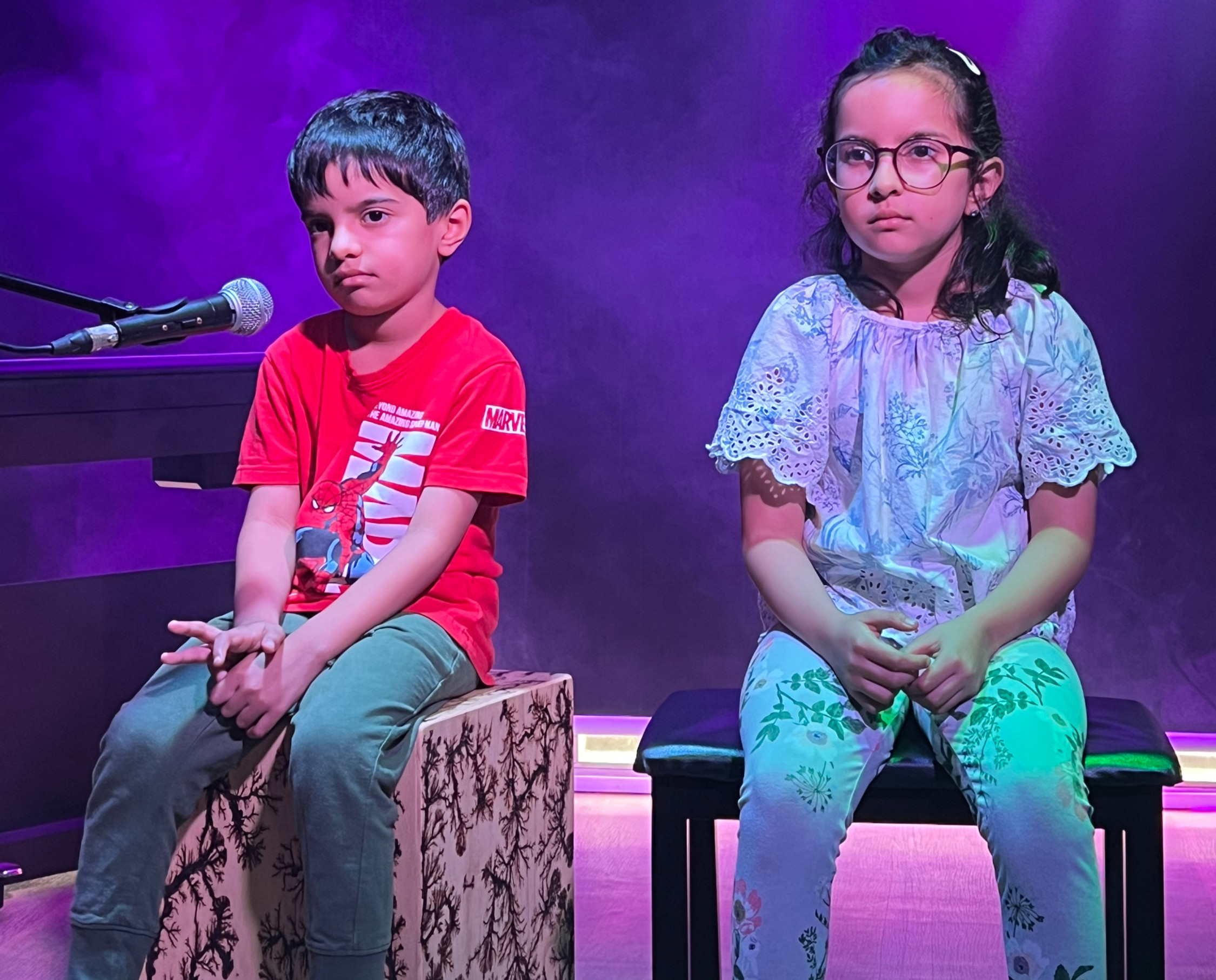
Almost everything. Before deciding, you have a standing invitation to watch a Friday Live Drive, our weekly student performance evening, running every Friday for roughly eighteen months now. Students of every level perform on a professional stage: some polished, some visibly nervous, all applauded.
Watching other people's children up there answers the questions no demo or brochure can: What does a student here look like after one year? After three? How do teachers treat a child who fumbles mid-song? Do the teenagers still seem to want to be here? An hour in that audience tells you more about a school's culture than any document we could hand you, including this one. Just tell us you're coming so we can keep you seats.
How should you prepare? (Spoiler: you don't)
Bring the child. That's the list. No instrument, no prior exposure, no "teach them Twinkle Twinkle first so they don't embarrass us", please don't, actually, because pre-coaching muddies the fit signals we're reading. Budget 45–60 minutes at our Langford Road, Shanthinagar campus, and dress for comfort; there may be floor-sitting in the warmup.
The session is taken by senior faculty not a junior assigned to demos, because assessment is the hardest teaching skill we have, reading a child they've met eight minutes ago and being right about the next twelve months. Both parents are welcome in the studio; so are grandparents, within reason.
Who books a music class at 1 a.m.?
Parents, it turns out — constantly. Our enquiry logs show a steady stream of bookings and form submissions arriving between one and two in the morning, from parents doing this research after the house has finally gone quiet. It's a big part of why we moved booking fully online: the calendar shows real available slots, you pick one, and it is held for you immediately, no waiting for a callback during working hours you don't have.
If you're reading this at 1 a.m.: the slot you book now is confirmed now. And if you're still comparing schools, start with the complete guide to choosing a music school in Bangalore, it's the framework we'd want you to use on us and on everyone else.
Pick a slot online, it's held instantly, day or night and your child's written assessment is yours to keep whether you enrol or not. Quick question first? Send it on WhatsApp and you'll get an answer, not a follow-up campaign.
|
FAQ
Is the demo class at The Music School Bangalore really free?
Yes. The demo session, the written assessment, and the performance clip cost nothing and carry no obligation. There is no "registration fee" at the door and no offer that expires if you don't decide the same day. The assessment document is yours to keep even if you enrol elsewhere or nowhere.
Is there a minimum or maximum age for a demo class?
The Music School Bangalore runs 35+ courses spanning young children through adult learners, so there is no upper age limit, adult demos follow the same assess-then-recommend format. For very young children, the honest answer sometimes appears in the assessment itself as "wait six months," with suggestions for musical play at home in the meantime.
Can both parents attend the demo class?
Yes. Parents sit inside the studio for the full session at The Music School Bangalore, not in a waiting area and both parents, or a parent and grandparent, are welcome. Watching the session yourself is part of the design, since you should be assessing us while we assess your child.
What if my child freezes and won't participate?
It happens, it's normal, and it isn't wasted. The teacher slows down, switches to quieter games, and reads what they can; some of our steadiest long-term students froze at their first demo. If the session yields too little to assess honestly, we simply say so and invite you back another day rather than writing a guess into the assessment.
Do we need to choose an instrument before booking the demo?
No, arriving undecided is the ideal case. The warmup games at a Music School Bangalore demo are designed to point toward the instrument that fits your child, and the recommendation comes with observed reasons. If your child already has a strong preference, we'll start there and verify the fit rather than override it.


Comments